Jun 12, 2026
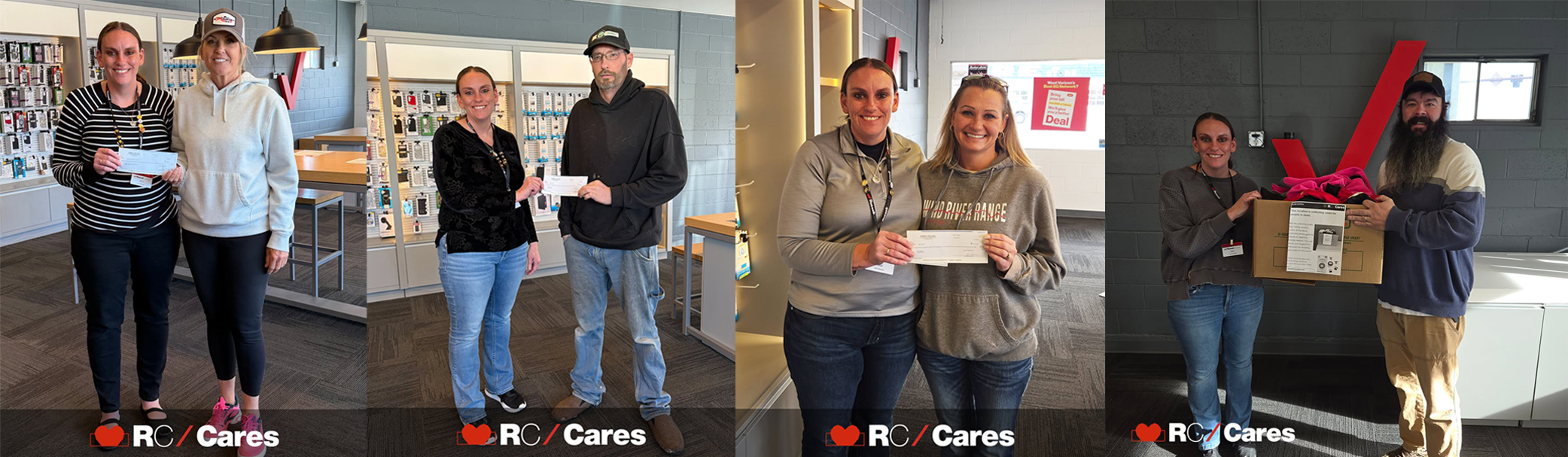
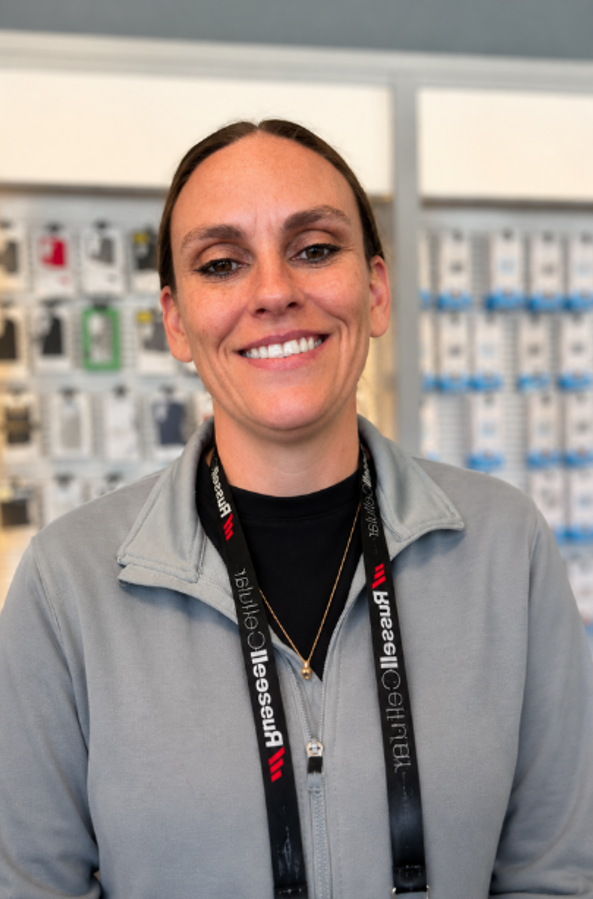 In Pinedale, Wyoming, with its population of just over 2,000, a Russell Cellular store is keeping its impact local but powerful. This year, a small team and generous community raised more than $2,000 to support local families and individuals, under the direction of RC Cares district leader and store manager Arla Bujanda.
Causes the team has supported include community members with cancer, animal shelters, food drives, school supply drives, and school trips. Arla, who has been store manager for a little over a year, says that she tries to support a new cause every month. “I do these fundraisers to show people that there is help and hope for them,” she says of the fundraisers that focus on families and situations. “(It helps them to) know kind people are willing to take some stress off of bills and expenses.”
Through purpose-driven meetings and ongoing support from leadership, Arla can execute her monthly goals effectively. Her team says she truly sees the value of RC Cares and reflects that in how she advertises her projects.
One of Arla’s store team members, Raelynn Mitchell, says that RC Cares projects matter to her and the staff because they often have personal connections to the causes. “Sometimes I know the families, sometimes I go the shelter myself to help with the dogs,” she says. “It’s a personal thing. I help out where I can.”
#RCCares #BetterTogether #CareForEveryPerson
Check out more RC blog articles.
Jun 10, 2026
Russell Cellular Provides All Employees with Three Key Advantages
While operating over 700 Verizon stores nationwide, Russell Cellular (RC) puts remarkable focus on caring for its team members across the country. When teammates feel supported, the results speak for themselves: stronger performances, people helping each other succeed, and employees who choose to build long-term careers with RC. It’s a true win-win – and Russell Cellular wouldn’t have it any other way.
Because RC is a large, diverse, and ever-evolving organization, leadership is intentional about creating a consistent, positive experience for every team member. That commitment is anchored in three Employee Experience Pillars that guide how the company operates: Opportunity, Value, and Team. These aren’t just aspirational ideas – they’re promises RC works hard to deliver every day.
“Opportunity” Working at Russell Cellular: Great Things Are Probable
Here’s a fun fact: the word opportunity comes from the Latin portus, meaning “harbor” or “safe passage.” It originally referred to a favorable wind that helps a ship reach shore. That idea of a safe harbor still resonates – and it fits perfectly at Russell Cellular.
A safe harbor can look like stability, freedom to work in a positive environment, strong mentorship, pride in your work, or simply ending the day knowing you made a difference. At RC, outcomes like these aren’t just possible – they’re probable. And the proof can be found in teammates across the organization.

RC recruiters focus on more than resumes. They look for character, talent, and potential. Once hired, employees are nurtured like rare seedlings in a carefully designed environment – one that includes the right setting, tools, information, leadership, training, motivation, and clear development paths. All of it is designed to help people grow, often beyond what they thought possible.
In return, teammates bring integrity, initiative, expertise, and a genuine service mindset to their work – helping the company fulfill its mission one customer at a time.
As stated in RC’s Training Roadmap:
“Every team member has the opportunity to contribute, learn, and advance based on merit. [RC] provides the opportunity for personal and professional development in a professional environment.”
“Value” Working at Russell Cellular: We See You – and We Mean It
Russell Cellular began as a small operation run by a hardworking married couple. Over time, a few smart, motivated people joined, then the founders’ children, and before long the company expanded across multiple states with thousands of employees. Through every stage of growth, one thing never changed: respect for the value of each individual.
Founder Jeff Russell understood early on that people drive success, and that belief is still deeply embedded in RC’s culture today. Caring for every team member remains a cornerstone of how the company operates.
In a sales-driven industry, recognition matters. RC offers performance incentives and prize competitions common to the telecommunications industry – including cash rewards, trips, and luxury items. But recognition doesn’t stop there. Top performers are also celebrated through company-wide acknowledgments, special merchandise, social media highlights, and opportunities for promotion and increased responsibility.

RC’s care for its people extends beyond the workplace. Employees have access, at no cost, to a comprehensive Employee Assistance Program (EAP) offering professional support and guidance to help navigate life’s challenges.
When those resources aren’t enough, the Employee Emergency Fund (EEF) – funded by employees at every level of the organization – steps in to provide financial help during times of real need. RC also makes a point to recognize birthdays, anniversaries, and important personal milestones – small gestures that mean a lot and are often overlooked elsewhere.
From RC’s Training Roadmap:
“We value every individual and strive to recognize and reward contributions to our success.”
“Team” Working at Russell Cellular: No Weak Links Here
Some people want nothing more from a job than a paycheck – and maybe a bigger one if possible, while focusing solely on their needs. That mindset doesn’t last long at Russell Cellular.
At RC, attitude matters. Values matter. Every role matters. The company’s mission is simple but ambitious: provide the best wireless experience to every customer, every time. That only happens when teammates support one another and step up when help is needed.

Telecommunications is a team sport. Every link in the chain must be strong for the system to work. At RC, everyone is both a teacher and a learner, a leader and a follower – relying on others and being reliable for others in return. Military veterans often thrive in this environment, bringing with them a deep appreciation for teamwork from day one.
Team members also have opportunities to give back through RC Cares, a company-supported initiative focused on meeting real community needs. A dedicated department identifies local opportunities, while RC stores, the Home Office, and paid employee volunteers come together to make a difference. Russell Cellular doesn’t just aim to be a good corporate citizen – it empowers its people to be Good Samaritans in their own communities.
As RC’s Training Roadmap puts it:
“The talents, dedication, and performance of each individual working as a team determine our success. We work as a team to help each other achieve our individual goals and accomplish our shared objectives.”
Interested in becoming part of the Russell Cellular team? Visit our Careers page to learn more.
#RussellCellular #BetterTogether #EmployeeExperiencePillars #PeopleFirstWorkplaceValues #JoinUs #CareerHere
Read other RC blog articles.

Jun 1, 2026
Things are expensive these days.
If anyone would like to create an immediate and deeply visceral response in a conversation, talk about money. In fact, it makes up one of the four ubiquitous, off-limits conversation topics: politics, religion, sex, and money. If that wasn’t enough, not only is our financial situation one of the most personally sensitive points of view, but it’s also a leading catalyst for divorce and overall relational conflict.
Therefore, money, specifically what we have, how we spend it and where, will always be a thing we hold close to our chest as we make our choices in our fixed and discretionary spending.
When it comes to things being “expensive”, well, that is relative. I contend everything is expensive until value has been established. Then it becomes a balancing act of to what extent our value meets our capacity to pay for the thing or things we want, need, or desire.
“During these economic times…”
Ok, first off, let me temper everything that follows with acknowledging the realities of the cost of living. I am not immune to this very real thing each day, week, month, and so on. Here’s the thing, I am not sold on the idea that these current times are unique. Every generational group has had an economy with which they have had to navigate their spending realities.
Times with market crashes, world wars, pandemics, and a variety of local, national, and global events of all categories have challenged our ability to buy, sell, transact, save, invest, and so on. If we have a little or a lot, the zeitgeist, or the spirit of the times, influences our wallets.
Context is everything.
I am going to challenge “During these economic times” through the lens of retail, and specifically what we do as retailers, which is to sell lots of stuff. Let’s start right there. When one works in retail, the job, regardless of whether it is customer facing or not, is 100% about selling what it has or supporting those who do the selling within some respective organizational role.
You see, I started in an era of retail where it seemed the three most important KPIs (Key Performance Indicators) were CR, AS, and IPS. That is to say…Conversion Rate or how many sales vs. opportunities. Average Sale or the total dollar amount of each transaction. And Items Per Sale or…well, that one seems obvious. The key thing uniting all three, the more the better.
My first legit retail job was selling clothes. I learned early on that it was unconscionable to sell just one thing. For example, we never let a suit go out without two dress shirts, three ties, a belt, and maybe some shoes. Why that much? Because a suit was an investment, and the goal was to ensure the customer could make the most of their purchase.
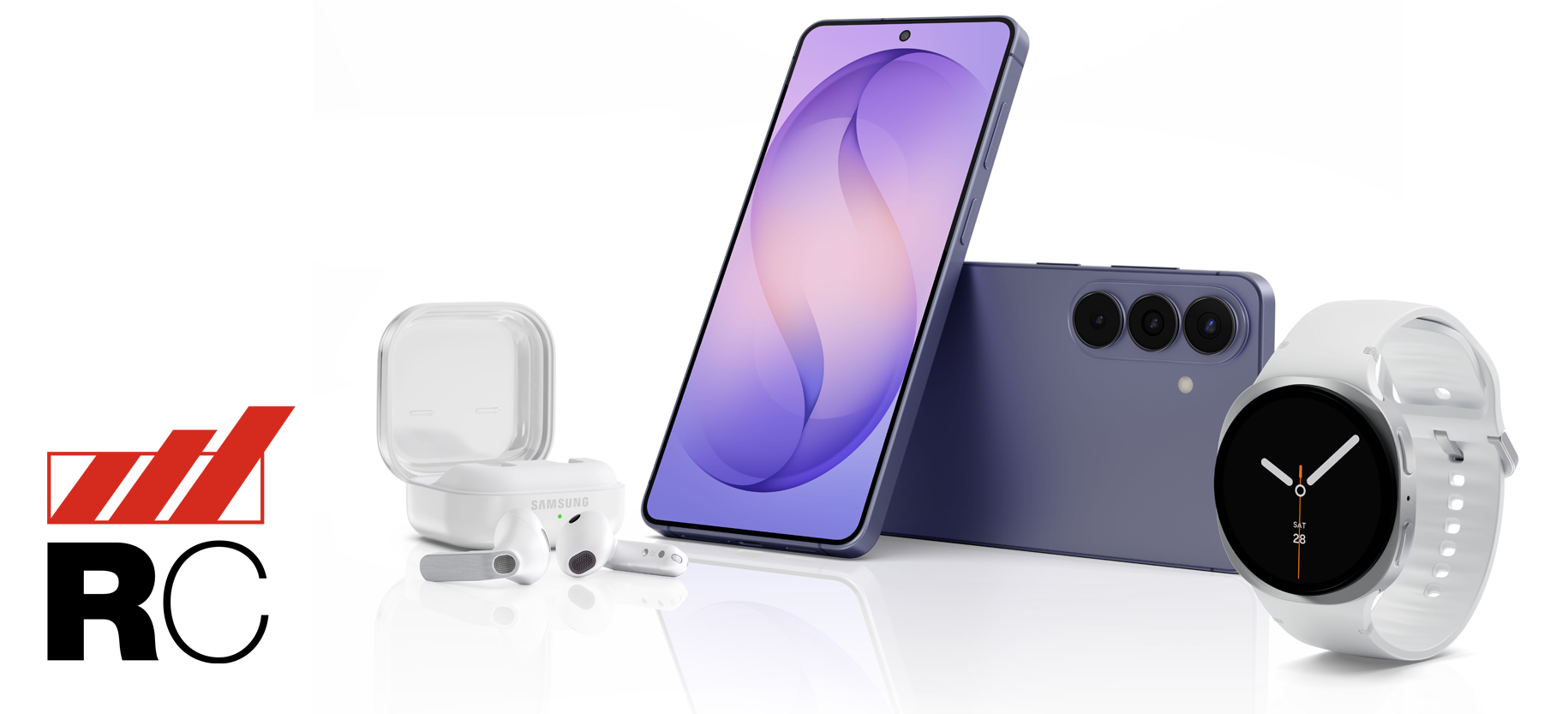
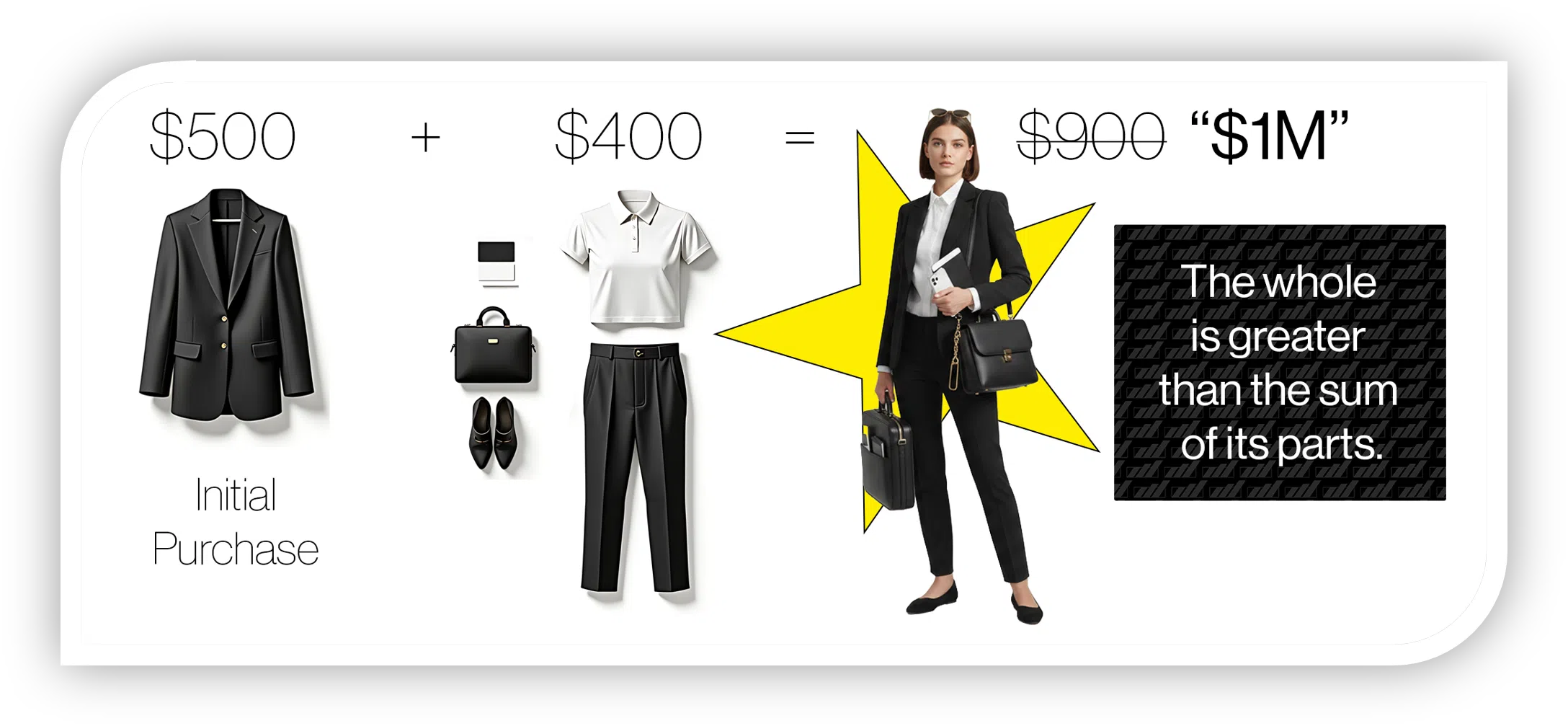 Now pivot over to wireless. The same is true, and even more so. Here’s why. It wasn’t that long ago at a wireless convention, maybe 16 years ago, where the idea of someone spending the money to buy a smart phone was a question mark. The price point seemed too high. And now, we cannot even imagine not having a smart phone. We went from about a 25% take rate then to being well over 100%. In fact, our saturation rate is way over 100%.
Which challenges the question, especially to someone who is new to retail, “during these economic times”, will people buy more than just the phone? And I say resoundingly, “heck yeah”. Just like the suit, it’s an investment. We go everywhere and do everything with our handheld, minicomputer. It links us to almost every aspect of our life. It requires protection, power, and performance to maximize overall value and usage. As well as all the connectivity with family, lifestyle, and business opportunities.
In fact, wherever we are and whatever we do, we will never give up our phones…even in and especially during these economic times. We probably depend on them more now. And we need more than just the phone. Each item offered adds value to our customers’ lives, and we get to help with that.
‘Value’ and ‘Service’ Prevail Over ‘Expensive’ and ‘Economy’
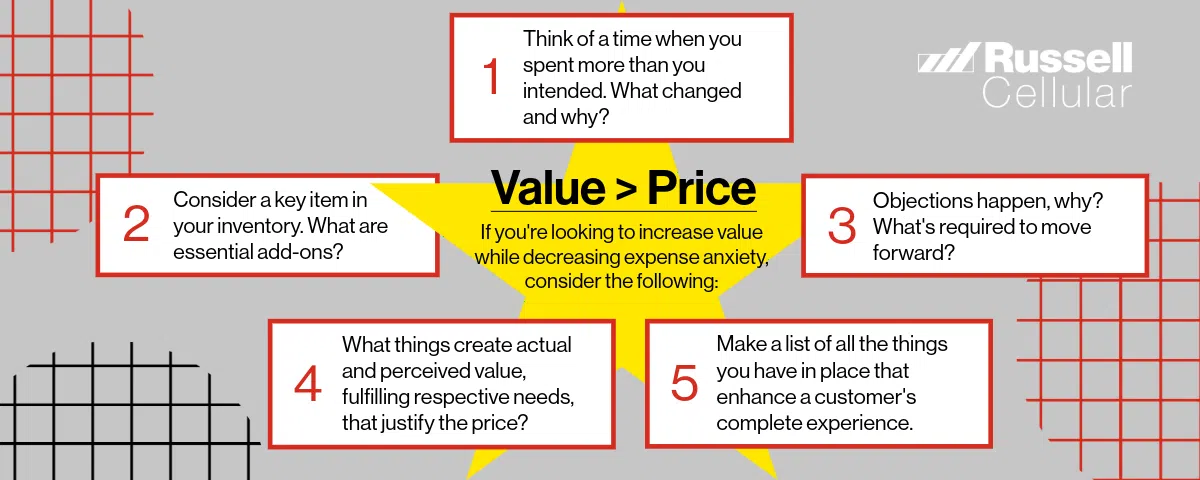
Let’s be real, price does matter, even when value is being established. What makes a distinct difference is when we help the customer align what they want and what they need with the most reasonable and cost-effective solution. Where the selling focus is not to blindly get the customer to buy more, but to intentionally help them buy right.
The key to making that happen is the quality of service before, during, and after. Beyond the disclosed features and benefits that align with the customer’s buying decision. It’s the relationship created and the behaviors demonstrated to each customer. It’s in the crafting of the relationship through…asking the questions, getting to know the customer and their wants, needs, and desires, making the recommendation for the total solution, working through setting them up properly, and then ending with a transaction AND establishing a relationship that lasts.
Bottom line, expensive, economy, price, value…it’s all relative. Keep that in perspective. The focus is making the most out of the investment. At Russell Cellular, maximizing value is the common denominator in all that we do. Caring for every person is how we do it.
#Verizon #5G #LTE #Fiber #RussellCellular #BetterTogether #LeadershipMatters
Check out other RC blog articles.

May 21, 2026
Every meaningful relationship gives us something – purpose from faith, encouragement from friends, support from partners, perspective from strangers, and stability from the places we work. At the heart of all of this is a simple principle that never goes out of style: treat people the way you want to be treated.
That belief is central to life at Russell Cellular (RC), one of the nation’s leading Verizon Authorized Retailers. The company invests deeply in its people – creating a world‑class employment experience that supports teammates professionally, financially, and personally. In return, Russell Cellular employees show up every day guided by shared values: integrity, expertise, initiative, and service to clients and teammates alike.
This people‑first philosophy benefits everyone – employees, customers, partners, and the communities Russell Cellular calls home. Decades of doing business with empathy, ethics, and genuine hospitality have proven not only rewarding but sustainable.
Here’s what sets a career at Russell Cellular apart.
Unlimited Earning Potential That Rewards Performance
At Russell Cellular, retail sales roles like Wireless Specialists and Store Managers go far beyond an hourly wage. Employees earn standard base pay plus uncapped commissions, allowing motivated teammates to directly influence their incomes.
The company regularly sweetens the deal with:
- Sales contests and performance incentives
- Cash bonuses, luxury prizes, and paid trips
- Advancement opportunities with increased responsibility and compensation
Promoting from within is a common practice at Russell Cellular. When teammates grow their skills and deliver results, the company responds with retail career advancement and unlimited earning potential.
Employees also enjoy meaningful financial perks, including:
- Exclusive discounts on Verizon wireless plans, home internet, and accessories
- Savings on popular devices like smartphones, tablets, smartwatches, and earbuds
- A strong 401(k) match (restrictions apply), helping teammates plan for a real retirement
- Same‑day pay options, offering flexibility and financial control
Russell Cellular understands that financial security fuels motivation – and they back that belief with real benefits.

Feel Good, Perform Better – Work/Life Balance is a Priority at RC
Taking care of customers starts with taking care of employees. Russell Cellular offers comprehensive health, dental, vision, and life insurance, partially funded by the company, because healthy teammates are essential to long‑term success.
Qualified employees receive:
- Paid time off for rest, recovery, and personal needs
- Time to heal without the stress of lost income
- Flexibility to manage appointments, vacations, and family responsibilities
Paid holidays are also part of the experience. For eligible full‑time and salaried non‑exempt employees, Thanksgiving and Christmas Day are company‑paid holidays.
When employees feel supported physically and mentally, they perform better – and Russell Cellular makes that support a priority.
Better Together: Teamwork, Training, and Support at Russell Cellular
No one succeeds alone, and teamwork is woven into everyday life at Russell Cellular. Continuous learning and professional development are critical to the company’s success –and managers actively guide employees along structured, customizable growth paths. For this reason, RC has developed a sterling reputation as a good company to work for among the most notable companies that promote from within.
Teammates benefit from:
- Ongoing in‑store and on‑the‑job training
- Sales coaching, performance analytics, and marketing support
- Interactive learning tools and executive insights
And when life throws unexpected challenges, Russell Cellular steps up. Through its Employee Assistance Program (EAP) with Anthem, employees can access free resources like:
- Mental health counseling
- Legal and financial guidance
- Identity theft protection
For emergencies that require direct support, the Employee Emergency Fund (EEF) – funded by company leaders and generous employees – provides relief to teammates in crisis.

One Great Employee Benefit: Caring for Communities Through RC Cares
Russell Cellular’s commitment to people extends beyond its stores. Through the RC Cares initiative, employees are empowered to support local communities – whether through fundraising, donated labor, or direct assistance to those in need.
Supporting teammates as they give back creates a powerful win‑win: stronger communities and more connected employees.
Career Growth with a Company Going Places
Recognized on the Inc. 5000 list of Fastest‑Growing Private Companies in America for nine consecutive years, and inducted into the Inc. Hall of Fame, Russell Cellular is a company built for the long haul. As one of Verizon’s top five authorized retailers, it operates hundreds of stores with thousands of employees across dozens of states.
That scale creates opportunity.
Russell Cellular consistently promotes from within, filling leadership roles with people who already understand the culture, customers, and mission. Employees who relocate can often transfer to another Russell Cellular location without sacrificing pay, benefits, or growth opportunities.
Whether moving upward, forward, or somewhere new, teammates are encouraged to build careers – not just hold jobs.

Come as You Are. Grow Into Who You Can Be.
Russell Cellular is proud to be an Equal Opportunity Employer, but diversity and inclusion go far beyond compliance. The company values individuality and celebrates the differences that make teams stronger – across backgrounds, ages, identities, styles, and experiences.
Employees featured in RC Cares and marketing materials are real teammates doing meaningful work in real communities. Policies, training, and leadership all reinforce a workplace where everyone is respected, supported, and given room to grow.
Russell Cellular Careers: Start Here and Go Further Than You Imagine
Wherever Russell Cellular employees begin, those who stay often look back amazed at how far they’ve come – professionally, financially, and personally. With support, opportunity, and purpose, growth becomes inevitable.
If you’re ready to build a career where people truly matter, your journey starts at the Russell Cellular Careers page.
#Verizon #5G #LTE #Fiber #WorkingAtRussellCellular #EmployeeExperiencePillars #UnlimitedEarningPotential #RCCares #CareForEveryPerson #RussellCellular #BetterTogether #CareerHere
Read other RC blog articles.
May 19, 2026
 As a District Sales Manager, Muhammad brings a leadership perspective shaped by his own journey through Russell Cellular – from new hire to leader. His experience reflects the impact of strong onboarding, supportive leadership, and a culture built on growth. He shares these reflections in his own words:
Looking back, I remember well what it was like to be new at Russell Cellular – but now, as a District Sales Manager, I can clearly see how impactful that experience truly was.
From day one, my onboarding felt both supportive and structured. The leadership team made sure I had the resources, guidance, and training needed to succeed, but what stood out most was the collaborative environment – everyone genuinely wants to help each other improve and win together.
One of the reasons I was drawn to RC was its reputation for growth and its family-like culture, where hard work doesn’t go unnoticed. That became real for me almost immediately. Building relationships early on helped me learn quickly, ask better questions, and develop trust with the people around me.
Now, in my role as a leader, I try to create that same experience for others.
If I could give one piece of advice to new hires, it would be this: be coachable. Ask questions, take feedback seriously, and focus on building strong habits early. Most importantly, stay aligned with our mission – delivering the best wireless experience to every customer, every time.
If you stay consistent, keep a positive attitude, and take care of your customers, the results will follow.
#Verizon #5G #LTE #Fiber #RussellCellular #BetterTogether #Perspective
Check out other RC blog articles.
May 12, 2026
Russell Cellular Regional Director Nick Nuñez writes:
As a leader, I’ve been fortunate to see firsthand the kind of impact we can make when we lead with purpose.
That mindset really took shape for me in 2025 when I was a District Sales Manager. For six months, our district ranked #1 in RC Cares sales – not because of a number we were chasing, but because we focused on causes that were personal to our team.
One of those causes is especially close to me – dog rescue. I’ve always loved dogs (I have seven of my own – 13 if you count fosters), and I was able to rally my district around supporting a local foster program. Together, we raised over $6,000 through RC Cares.
That effort turned into something even bigger. Not long after, I drove 41 rescue dogs to Canada in a van that had been repaired using RC Cares funds – helping them reach their forever homes. It was a 60-hour journey from Friday morning to Sunday evening, with just one stop to shower – but it’s something I’ll never forget.
We also supported causes closer to home. When a team member’s mother was diagnosed with a rare form of cancer and could no longer work during treatment, our district came together to raise more than $3,400 to support their family.
Moments like these are why RC Cares matters. It’s not just about raising money – it’s about creating real impact for people and communities we care about.
A lot of that inspiration comes from leaders like (RC Cares Director) Ron Wallace and (Regional Director of Sales) Jeremy Willams. They lead with generosity and heart, and they’ve helped shape how I approach giving back – making it personal, meaningful, and something our teams can truly rally behind.
#Verizon #5G #LTE #Fiber #RussellCellular #BetterTogether #RCCares #Purpose
Check out other RC blog articles.