
Jul 30, 2025
Who Does Culture Well?
In 2015, a CEO in Canada asked me that question over dinner after a leadership workshop. We had been talking about the steps in building a desired culture. To create a little context, I told a story from back in the day.
There was a speaker at a conference who asked the audience a question, “Who is the best at customer service?” Many answers were thrown out until one stood out above the rest…Nordstrom. The speaker asked the audience, “How many of you think Nordstrom’s has great customer service?” Nearly all the hands were raised. The speaker said, “Keep your hands up if you have actually been in a Nordstrom’s store.” More than half the hands went down.
I have heard this shared repeatedly and often wondered if it was the truth or merely an urban legend to prove a point. Either way, our excellent customer service experience tells a story of culture. We have all heard stories about businesses that get it right. We even have our favorites. Amazon. Starbucks. Southwest. And yes, Nordstrom. Whether it is our experience or someone else’s shared story, culture is a byproduct of behavioral choice; those choices create an experience, and the expertise influences a reputation. And the reputation can very well precede any subsequent experiences.
What is “it” That Makes a Good Experience?
If you are a customer, it could be many things. It is the widget. It is the products and services we want or need. Also, it could be the vision or backstory of the business we like. We like their cause and who they are as a company. They stand out in the marketplace or the community very compellingly. Maybe it is the people we like—their personality, energy, and enthusiasm. The team is well-trained and expert at what they do. They legitimately care about every person. Or it is the way they conduct the business. The process. It is like clockwork, and the consistency is seamless. We know that when we show up, everything flows.
Let us be real: culture can be the feeling we get, and we like that feeling. When all those things collide, the result…it feels right. It is the experience: the products, the vibe, the people, the systems, the interaction. If broken apart and viewed only as parts…each have a place. They are all important. It is the sum of all parts. For the customer.
As it pertains to the company, one of my peers shared a perspective that really hits home. “Culture is the sum equation of what you promote and what you permit.” This suggests it is still a matter of choice. In fact, all the things that the customer likes in their experience are all guided by the efforts of managers and leaders to make them happen through the efforts of their teams.
All the things that the customer needs, wants, or desires are influenced by how the business supports and directs the behaviors to make it all happen. So then, culture is an output. Good or bad, companies create and external experience (for the customer) and internal experience (for the team member) by what they inspire and what they allow.
It is pretty simple. If it is a good experience, we remember it. If it is bad, we tell everyone. Yes, in retail as in life, our reputation proceeds us. We are all advocates in one way or another. We celebrate and forewarn. Culture is something we can see, hear, feel, and store way in our memory.
So, who does culture well? It depends. I’ll leave that up to you.
If You Are Interested, Consider Some of the Following Questions.
- First off, how do you define “culture”? What about “good culture” or “bad culture”?
- What is the story circulating about your company and the customer experience it provides?
- How are the people around you taught the culture?
- How do people demonstrate the culture where you work?
- Do the people around you believe in the culture, especially what, why, how, and to what extent?
- What systems are in place to reinforce the culture?
- What is promoted and what is permitted, and how does it all get managed?

Jul 21, 2025
Smart Businesses Save More, Here’s How Verizon Helps Yours Do It
Suppose you are launching a business or celebrating a new milestone this July. In that case, one of the best investments you can make is choosing a reliable, scalable, and cost-effective provider for your internet and wireless needs. That is where Verizon Business comes in.
How can Verizon Lower Business Expenses?
Verizon offers tailored business packages that do more than connect you; they protect your bottom line. With bundled plans, flexible pricing, and powerful tools built in, you will immediately reduce overhead costs and increase efficiency.
How to Lower Business Expenses
Verizon also helps reduce the hidden costs of poor service, like dropped calls, slow connections, or missed opportunities.
Can I Use Verizon Home Internet for My Business?
If you’re a solo entrepreneur working from home or just getting started, Verizon 5G or LTE Home Internet might seem like an easy, affordable choice. And for some, it works—especially if your needs are light (email, web, Zoom calls).
But here’s the truth: If your business is growing or relies on fast, secure, and stable internet, Verizon Business Internet is the better long-term investment.
It offers:
Bottom line: Home Internet works in a pinch, but Business Internet is built to grow with you.
Verizon makes it easy to match your business needs with the right plan:
- Business Fios: Best for Office-based teams and offers fiber-fast speeds, symmetrical upload/download and is ultra-reliable.
- 5G Business Internet: Works for Retail, pop-up shops, and remote setups. Its key features are wireless flexibility, fast setup and high speeds.
- Wireless Business Plans: For Mobile Teams and on-the-go pros. This is how you lower business expenses with device bundles, shared data, and premium features.
You can also bundle Business Internet + Wireless to get even greater value, plus support tools like One Talk, cloud storage, and mobile device management to keep everything connected.
Final Thoughts
Don’t settle for slow, residential service or confusing pricing. Verizon helps you spend smarter and scale faster, whether you’re just getting started or planning your next big move.

Jul 15, 2025
Have you been looking for ways on how to start a business? Verizon offers tailored solutions for businesses of all sizes—yes, even yours. Whether you are running a home-based business, a growing startup, or managing multiple locations, Verizon has the tools to help you thrive.
What Type of Business Does Verizon Support?
Verizon supports a wide range of businesses—from sole proprietors and remote workers to enterprise-level organizations. Whether you are a freelance graphic designer working from home, a retail shop owner, or a field-based construction business, Verizon Business provides scalable solutions that fit your needs.
Examples of Businesses Verizon Supports:
- Home-based businesses (consultants, creators, e-commerce sellers)
- Small-to-medium-sized businesses (SMBs) (boutiques, salons, local services)
- Mobile workforces (construction, real estate, event planning)
While Verizon Home Internet (including 5G and LTE Home) may suit very small or home-based businesses with basic connectivity needs, most growing businesses will benefit more from the enhanced speed, security, and reliability of Verizon Business Internet. If you rely on multiple devices, handle sensitive customer data, or need consistent performance to support your operations, Business Internet is the smarter, more scalable choice.
For businesses that handle sensitive customer data, operate multiple connected devices, or need priority support and advanced networking features, Verizon Business Internet is the smarter option. It includes options like Business Fios, 5G Business Internet, static IPs, and professional installation.
Why Should You Use Verizon to Start a Business?
Verizon is not just a phone company—it is a business partner. Here is why so many entrepreneurs and companies choose Verizon to power their operations:
- Reliability: Verizon has one of the most reliable networks in the U.S. for both wireless and wired services.
- Speed: From fiber to 5G, Verizon delivers the speed businesses need to stay productive.
- Scalability: As your business grows, Verizon offers flexible plans and products that grow with you.
- Security: Verizon Business Internet and Mobile plans come with advanced security features and available add-ons to protect your operations.
- Support: 24/7 business-grade customer support ensures you are never left in the dark.
How to Get Started with Verizon for Your Business
Getting started is easier than you think. Here is how:
- Identify your business needs
Are you mobile? Office-based? How many employees? What devices do you use daily?
- Explore Verizon Business Solutions
Visit a Russell Cellular location to compare plans and solutions or speak with a Business Specialist.
- Choose the right internet and mobility solutions
Whether it is Business Fios, 5G Business Internet, or wireless plans for your team, Verizon will help match you with the best setup.
- Get set up and stay supported
Enjoy professional installation, ongoing support, and the ability to scale up as your business grows.
Final Thoughts
Starting or upgrading your business with Verizon means you’re investing in connectivity that works as hard as you do. From day one to scaling success, Verizon is ready to support you every step of the way.

Jul 11, 2025
Samsung has just announced the all-new Galaxy Z Flip and Fold 7. These two devices will hold similar designs as previous ones but come with upgraded tech. From pro-level 50MP selfies to personalized briefings. Experience pocket-perfect AI in the thinnest Galaxy Z Flip and Fold 7 yet. In this blog, the Samsung Galaxy Z Fold7 and Z Flip7 Specs will be broken down and compared.
Samsung Galaxy Z Flip and Fold 7 Colors
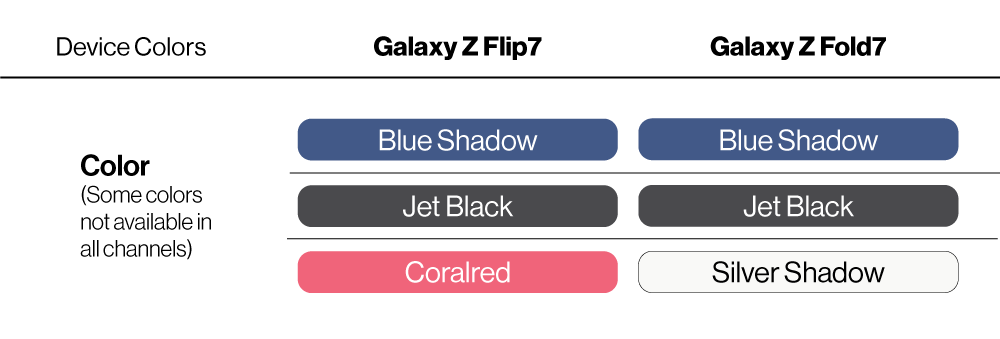
With this launch, Samsung is sticking to mostly basic tones for their phones with the exception of the Coral red color for the Z Flip 7. The Z Flip 7 will also include two other colors such as Blue Shadow and Jet Black. The Galaxy Z Fold 7 will have similar colors with the same Blue Shadow and Jet Black Options, but the third color will be Silver Shadow which is basically white.
Screen Specs

There are not many differences between the Galaxy Z Flip 7 and the Galaxy Z Fold 7, other than the obvious. The Fold 7 will come with a bigger screen at 8″ on the main, and 6.5″ on the cover. The Flip 7 will come with a 6.9″ main and a 4.1″ cover. They will both receive the same display type with a 120 Hz adaptive refresh rate. The only difference being in the processor where the Z Fold 7 will have a slightly stronger processor due to its bigger screen size. When comparing the two phones, the Z Flip 7 has a more compact design being able to fold into a small square. While the Z Fold 7 would work better for multitasking, watching content, and gaming.
Innovative Camera

One of the more noticeable differences between the two phones lies within the camera specs. The Samsung Galaxy Z Flip 7 provides more of a general camera. However, do not let that fool you, it has strong power behind it with 4K @ 60fps video. With the Galaxy Z Fold 7, you will get all the features of the Flip 7 but more. You can not only video in 4k, but you can record in 8K as well. Pairing with its Wide and Ultra-Wide lens options, the Fold 7 offers a Tele 3X zoom lens to get those distance shots perfect. With every family trip you will have high quality memories in the palm of your hand.
Additional Specs

The last specs for the Samsung Galaxy Z Flip & fold 7 we will take a look at are the Memory, Battery, and Security features. Both phones will receive the same hardware for this with the only difference being that the Flip 7 will have 1 less hour of usage time. Both phones will be equipped with a fingerprint sensor, facial recognition, and be secured with Knox Secure. Each phone will also have upgraded 12GB DDR5 RAM to power your everyday tasks with ease.
When & Where?
The Samsung Galaxy Z Flip7 and Z fold7 are up for Pre-Order today and will soon be released July 25th, 2025. You can check out the latest deals on new phones or upgrades for the Galaxy Z Flip and Fold 7 series on our product page. Or you can visit one of our locations to speak to someone in person.

Jul 1, 2025
Never put off until tomorrow what you could do the day after tomorrow.
That’s a quote loosely attributed to Mark Twain. It’s a cheeky way of calling out extreme procrastination and highlighting the absurdity of delaying tasks even further.
It’s also a humorous counterpoint to something Benjamin Franklin famously said: “Never put off until tomorrow what you can do today.” This emphasizes the importance of not delaying tasks unnecessarily. While we all understand the need for efficiency, diligence, and follow-through, we still struggle with being mindful of how we manage our time and tasks.
Procrastination is…
The simplest definition of procrastination is the act of delaying or postponing tasks.
Being real, while I write this, I am knee-deep in some irony. I have procrastinated writing this blog for two weeks. I have had “other things to do,” and this task seemed to keep moving down the list until I realized, “Oh man, this is due tomorrow.” The thing is, I love writing, so it wasn’t procrastinating on something I don’t typically like doing. I believe this to be more situational irony.
This is an example of knowing I had an article to write, targeting it as a post on procrastination, and then allowing a thousand other things with varying degrees of importance and urgency to take precedence instead of just knocking it out. I think it was more a loss of sight than procrastinating. Regardless, I am clanking away at the keyboard in the eleventh hour before the deadline.
Procrastination is too easy.
Based on some research, the reasoning behind delaying tasks is more than mere laziness, lack of motivation, or poor time management skills. While those certainly can play a part, I have found that there may be deeper, more psychological factors in delaying select tasks.
Procrastination can stem from emotional responses like fear of failure, judgment, doubt, unrealistic expectations, low self-esteem/efficacy, or difficulty with emotional regulation. Essentially, procrastinators may delay certain tasks, even when they know it’s harmful, to avoid negative emotions associated with the task, thus creating a cycle of avoidance and increased stress.
It’s a cycle that begins easily enough with some immediate gratification by avoiding or doing something else (typically more pleasurable), and then the avoidance leads to longer term issues of stress and anxiety. To me it’s like having a cold. The truth is everyone will get it. The severity of it depends on how we treat it. The longer it lingers, the more dangerous it can get.
Stubbing out procrastination requires action.
If you want to eliminate or treat procrastination, it will require some intentional energy and effort. Dan Pink recently shared a vlog, This is How to Finally Stop Procrastinating; 7 ways to stop stalling and start moving. In this 10-minute video, Pink provides seven considerations to combat those urges to not do something or make it, whatever it is, less important. Here’s the seven things with a tiny bit of commentary.
Follow the two-minute rule. Whatever you can do in two minutes or less, just do it. Anyone can do 120 seconds. Let it stimulate more complex things that need to be done next.
Remake your environment. Create a workspace free of distraction and noise to help focus your productivity. Get rid of the stuff that can derail your effectiveness and follow through.
Bundle your temptations. Pair stuff you should do with stuff you want to do. Make the mindless and mundane mindful and meaningful.
Visualize future regret (and success). Allow your future self and the possible outcomes to direct how your present self decides to act and react in the current set of circumstances.
Break tasks into microtasks. This one is simple. Break down tasks into more do-able bite-sized chunks. Spread them out and then celebrate each completion as a means to keep going.
Make a public commitment. Let others know what you’re doing. This accountability makes it harder to avoid stuff if you know you have created expectations others are now watching.
Say, “Just five more.” Five more minutes, five more tasks, whatever; this is about giving and doing a little bit more each time. It’s challenging our drive and resilience to keep at it.
Procrastination is self-sabotage.
It doesn’t have to be. It’s a choice. So is engagement and getting after the stuff we need to get done. We get to decide how we respond to the important, urgent, and everything else in our day, which means ‘someday’ is not a day of the week. Get it done!
If procrastination is something you wrestle with, or may in future, consider your answers to some of the following questions.
- How do you define procrastination?
- What are some of the emotions that come to mind when you define procrastination?
- What are the tasks you typically avoid or put off? Make a list.
- Why do you typically avoid or put off those tasks?
- What tasks do you never avoid or put off? Make a list.
- What’s the difference between the lists?
- What is one thing you could start doing today to diminish procrastination in your life?